

Why TPLO?
Every dog and every surgical case is unique. Your veterinarian, in consultation with the surgeon, will determine the best procedure for your pet. The Tibial Plateau Leveling Osteotomy (TPLO) offers a reliable and early return to limb use and has been shown to have the best and most consistent outcome of all of the described procedures for cruciate ligament tears in dogs.
Tibial Plateau Leveling Osteotomy (TPLO) is an osteotomy-based, geometry-modifying procedure designed to alter abnormal forces that result from a ruptured CrCL. The TPLO decreases the slope of the tibial plateau to eliminate the instability associated with the CrCL tear in a way that the CrCL is no longer necessary to maintain stability. This is done by making a radial cut (osteotomy) in the proximal (near the knee) aspect of the tibia. The cut portion is rotated a specific amount to decrease the tibial plateau angle (TPA). Once the rotation is performed, a specialized locking plate and screws are placed on the tibia to stabilize the bone and allow it to heal.
Request a Consultation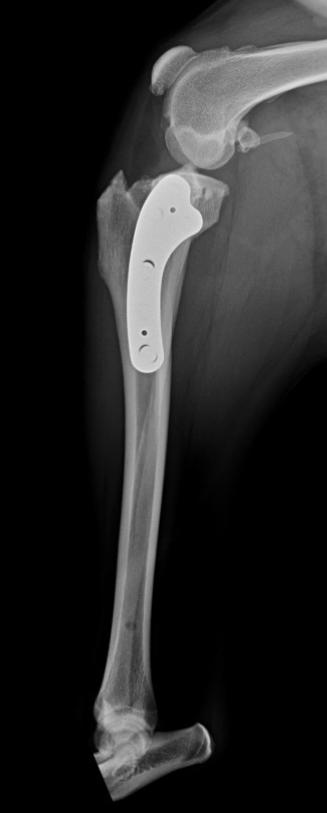
What is the prognosis with TPLO surgery?
The success rate with the TPLO procedure is very high. Over 90% of dogs return to a fairly normal activity level after surgery when post-operative care instructions are followed. With weight loss (for overweight dogs) and rehabilitation therapy, dogs achieve the best outcome. It is not unusual for a similar injury to occur in the opposite leg at some point in the future. This is due to the degenerative nature of the injury in most patients and is often seen within 1-2 years of the first side, but it can happen at any point after the first injury.
What are the possible complications with TPLO surgery?
A good to excellent result is expected in most patients. Complications are rare and several refinements to the TPLO technique have evolved over time to decrease the rate and severity of complications in the patient population. As with any surgery, however, some complications can occur. Dr. Price is an experienced TPLO surgeon and has performed many hundreds of cases. He utilizes techniques in surgery to lower the risk of major complications, incisional complications and surgical site infections.Surgical risks and complications associated with TPLO surgery include but are not limited to:
- Infection of the surgical site and/or Deep infection of the plate: Depending on the severity, additional testing and medications may be required. In some cases, this may require removal of the implants placed at the time of surgery.
- Late meniscal (cartilage cup) tears can occur in some patients following CrCL injury and TPLO surgery. This can occur two to six months after the operation and may require further surgery to remove the damaged cartilage. The published rate for this complication is between 3-5%, however in our experience, late meniscal pathology is much less common in our patient population.
- Hemorrhage at the time of surgery and/or bruising after surgery. As the swelling from around the knee travels down the leg due to gravity, there may be fluid accumulation at the ankle following surgery that typically resolves in days.
- Patellar tendonitis (inflammation of the patellar tendon) occurs commonly following TPLO surgery due to the altered forces acting on the joint and does not usually cause clinical problems. Infrequently, severe patellar tendonitis can cause pain and lameness and warrant treatment.
- Implant loosening and/or failure and fibula and/or tibia fracture are very rare but potential major complications which require an immediate surgical revision.
- Ongoing lameness, , cartilage wear, arthritis, meniscal damage, and concurrent disease in other legs or joints have been reported
- Nerve damage/injury is a rarely reported complication.
Adherence to post-operative exercise restrictions and guidelines will minimize complications and maximize recovery. Complications may require additional testing and/or medications and, in rare cases, additional surgery to correct.
What is recovery like after TPLO?
The goal after the TPLO is to allow the bone to heal while simultaneously improving the use of the limb and minimizing secondary soft tissue abnormalities. This is achieved with a combination of activity restriction, at-home exercises, and professional rehabilitation therapy if available. After surgery, dogs are typically non-weight bearing to toe-touching lame for the first few days. Shortly thereafter, dogs will begin to bear weight with an obvious lameness. When walking, they will use the limb, but they will often hold the leg up when standing. Within two to three weeks, they are using the leg consistently. By the six-week recheck and radiographs, most dogs are healed and may begin a gradual return to normal activity beginning at 10-12 weeks following surgery.
A comprehensive set of discharge instructions is provided for each patient and a base copy can be obtained upon request to help better understand the recovery timeline and rehabilitation exercises.